The Thyroid Cancer Modified Anxiety Scale (TC-MAX): Development and External Validation of a Thyroid Cancer…
The Thyroid Cancer Modified Anxiety Scale (TC-MAX): Development and External Validation of a Thyroid Cancer…
Can We Safely Shorten Antithyroid Drug Therapy in Lower-Risk Graves’ Disease? David Toro-Tobon
From Clinical Thyroidology® for the Public: Thyroid hormone plays a critical role in heart health….
Drs Kaniksha Desai and Shashank Joshi focus on the relationship between diabetes and thyroid disease….
From Clinical Thyroidology® for the Public: Cancer size has been one of the main factors…
Kaniksha Desai, MD and Michael Yeh, MD discuss the practical aspects of postoperative thyroid surgery…
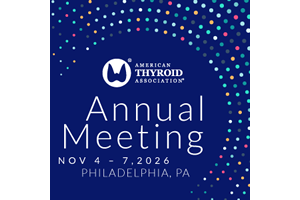
Sneak Peek of the 2026 American Thyroid Association Annual Meeting, November 4–7 in Philadelphia Michael…
Shorter Versus Standard Antithyroid Drug Therapy in Graves’ Disease with Lower Baseline Thyrotropin Receptor Antibody…
Thyroid® Journal – Editor-in-Chief Call for Applications The ATA seeks applications for the next Editor-in-Chief…
From Clinical Thyroidology® for the Public: Several options to treat Graves’ disease exist, including long…
 AMERICAN THYROID ASSOCIATION® , ATA® , THYROID® , CLINICAL THYROIDOLOGY® , and the distinctive circular logo are registered in the U.S. Patent and Trademark Office as trademarks of the American Thyroid Association® , Inc.
© 2026 American Thyroid Association.